It is the feast of St. Mark! The punctuation is intentional as Mark’s gospel is marked (no pun intended) by nothing if not breathless urgency. As I tell my undergraduate students, the Greek term euthus, typically translated in English as “immediately,” dominates Mark’s gospel. Mark’s Jesus is a man of action, healings, exorcisms, and confrontation with the powers of his day, the agent of the reign of God that is now “at hand” (Mark 1:14). Jesus’ coming demands an immediate and personal response of discipleship. The dramatic nature of Mark’s proclamation of Jesus Christ continues in today’s gospel, thought by many scholars to be a later addition. Whoever the author, this post-resurrection passage faithfully continues Mark’s high-stakes ethos: the disciples are to proclaim the gospel to “the whole world” and “every creature”; personal salvation hinges on both proclamation and response; eschatological signs and wonders will accompany the spread of the gospel to the ends of the earth. From start to finish, Mark’s Jesus exemplifies “the power of God and the wisdom of God,” to echo today’s gospel acclamation.
Yet as this same gospel acclamation reminds us, the great mystery of the incarnation is that the power of God is made manifest in “Christ crucified.” This is nowhere more evident than in Mark where Jesus, seemingly abandoned on the Cross, cries out to his Father, “Eloi, Eloi, lema sabachthani?” (Mark 15:34). It is Mark who writes of a Roman centurion–himself one of Jesus’ executioners–as the first proclaimer of Jesus’ divine sonship, a faith that is manifested not in response to the resurrection but as he gazes on the crucified Messiah: “Truly this man was the Son of God” (Mark 15:39). This paradox emerges also in today’s first reading where God’s exaltation comes only after Christians “clothe yourselves with humility in your dealings with one another” (1 Peter 5:5).
I write this reflection from Kenya where I have been moved by the faith of lay-led Small Christian Communities (SCCs) which provide the grassroots foundation of the Catholic Church in eastern Africa. Meeting in homes, these communities share on the upcoming Sunday gospel, pray the Rosary, reflect on their social context, and provide charitable support for each other. What strikes me are the faith and trust members express in God’s saving power, often expressed in what today’s psalm calls a “joyful shout,” even as these “brothers and sisters throughout the world undergo the same sufferings” (1 Peter 5:9). As one woman in a rural SCC proclaimed, “by showing love to one another, we create peace where there is no peace.” This is surely a message our church and world need to hear today.
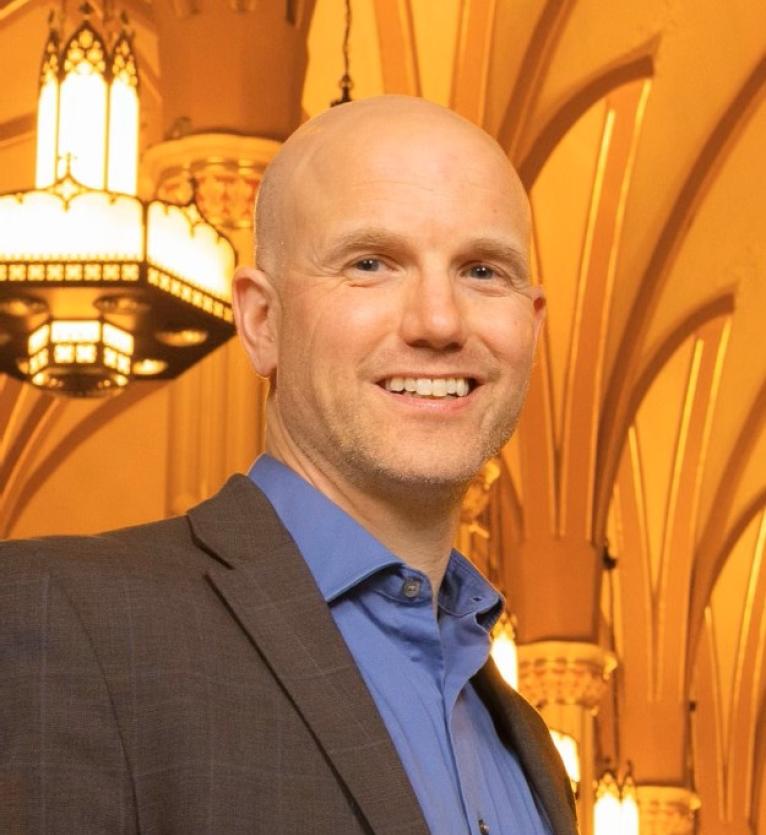
Jay Carney
I came to Creighton in 2011 and teach a wide range of classes here, from freshman theology through graduate seminars in Christian spirituality. My research engages questions of reconciliation, theology of sport, and World Christianity, especially Catholicism in modern Africa.
I am married with four children in secondary school and college. My wife Becky is a remarkable soulmate and friend, and our children have given both of us much love and laughter (and, of course, a few wrinkles). I grew up in the Washington, DC area and have also lived in Wisconsin, North Carolina, Arkansas, and Uganda. In my spare time, I enjoy reading, running, cycling, soccer, food, fellowship, and listening to music of all genres.
Writing Collaborative Ministry reflections is humbling…I’ve gained newfound respect for the homilist’s task! I feel that I am preaching to myself as much as anyone else. It’s wonderful to know that so many people are walking together as disciples of Jesus Christ. Thank you for your prayers!