Catherine of Siena is perhaps best known for her efforts to bring an end to the Avignon Papacy, her extreme penitential practices, reception of the stigmata, and for being named a Doctor of the Church. While these are all very interesting and important components of a complicated woman I find two other truths about her more compelling: the ways she lived in a balance of tensions, and the insights preserved in her own spiritual writings.
Catherine lived in liminal spaces. Though commonly referred to as a Dominican nun, she was actually a tertiary—a third order religious, who did not live in community under a community rule. She was a daughter living at home, and at the same time a hermit who isolated within that family home as if it were a cloister cell. She was a woman desiring solitude, whose vocation drew her into public spheres, often ones uncommon for women. She was an ascetic, but placed her reliance more on virtue than penance (The Dialogue, 17). She was a person who lived in the tensions.
Amidst those tensions Catherine entered deeply into the spiritual life, experiencing incredible insights from her intimate relationship with the Divine. She found the most stable cloister cell was an interior place, not dependent on physical location. In this inner cell she began to understand that her reverence for God is bound up with knowledge of herself. To know one’s self is ultimately to know God who “is,” because the self “is not” without God. She advances the basic Biblical proposition that we are made in the image of God, and goes so far as to say that “it is, indeed, through the effect of love, that the soul becomes another Himself…the soul unites herself with God by the affection of love” (The Dialogue, 1-2). Catherine’s language is that of relationship, not of obligation.
How might my spirituality be enriched by Catherine’s example? My life is very different from the medieval ascetic, and yet I suspect there are some universalities revealed through her. In a busy, noisy world I too can cultivate my own interior cell. In this place I can strive to deal honestly with myself, confident that such work leads me to deeper knowledge of “God who is.” I can learn to love myself, not in a selfish or self-aggrandizing way, but with the dignity of one called to be “another myself” by no less than the eternal God. I can also confidently say that in the midst of my own life’s tensions, in my gifts, desires, and foibles, in the messiness of myself and my world that I too can respond to God’s invitation. I won’t do it perfectly. Neither did Catherine. But, I can strive to work with God’s own self in me, faithfully in love.
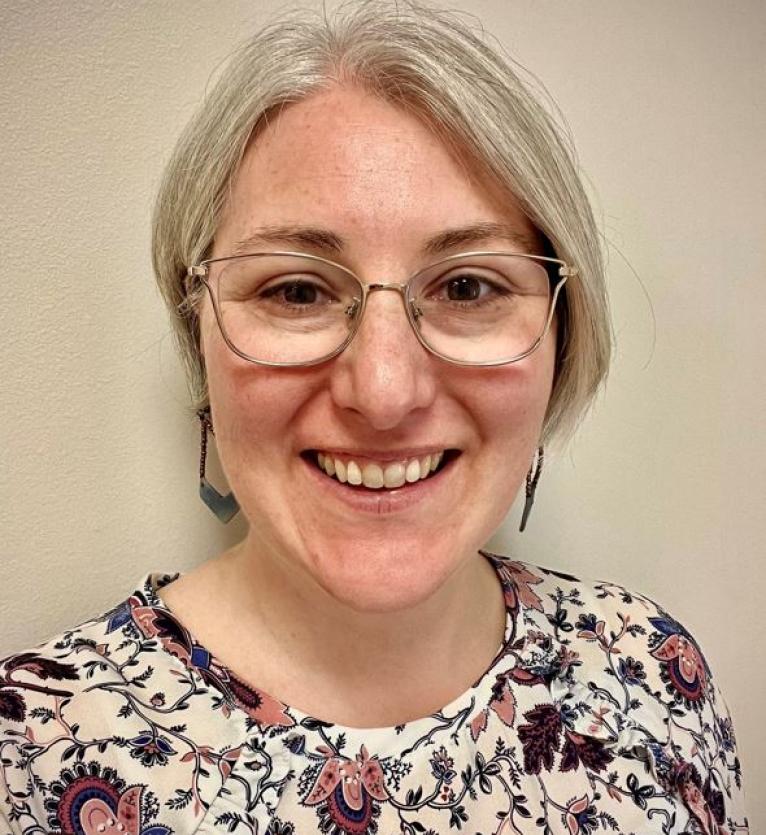
Sara Schulte-Bukowinski
Originally from central Nebraska, where my home diocese of Grand Island nurtured vocations to lay ministry, I pursued Divinity studies and completed my M.Div. at the Jesuit School of Theology at Berkeley in 2007. After 12 years of providing formation and education in Catholic schools, I spent 7 years as a lay pastoral minister (Parish Life Director) at St. John’s, Omaha’s Jesuit Parish. Most recently I took on another new role, now as Director of the Deglman Center for Ignatian Spirituality here at Creighton University. I live in Omaha with my husband Adam, our dog Lilly, and as of 2022 my parents-in-law Ann and George.
In graduate school I was fortunate to take a course from the illustrious theologian and Johannine scholar, Saundra Schneiders. I still remember her talking about the location where ongoing scriptural revelation occurs—in the space between the page and the eyes of the reader. This is where the Divine meets the realities of our lives, in our time and place. I look forward to sharing this encounter together as part of this reflection team.