It seems that recent world events and the Pope’s strength of conviction in his role as the interpreter of God’s word (my apologies to my Catholic friends if ‘interpreter’ is an insufficient word here, which I suspect it is!) have given us all pause to consider what power aligned with the Christian faith is called to do.
The secular world may need to establish and maintain borders, for instance, but the faith world demands, if it must be, that we consider how to do so in humane and loving ways. Pope Leo XIV has reminded us many times in the past year that Christ cared for the least of us, welcomed the stranger, walked among the discarded, called us to love one another. Jesus lived at the margins, not in the temples.
Yet in today’s Gospel lesson from Matthew 9, we see that Jesus responded to power. An “Official” came to Jesus, and kneeling before Him asked if He would accompany the man to his home where his daughter had just died. Who can say why Jesus stopped what he was doing to go with the man, but he and his disciples went, sent away the crowds, and pronounced that the girl was not dead but simply sleeping. The girl rose, and the story of this miracle spread. A cynic could easily dismiss the good deed here: of course things worked out. People of privilege like an “Official” can influence or buy positive outcomes. We might wonder: Why did Jesus help “that guy”, when so many other children die? Why was he more deserving?
Embedded within the story, though - almost as an aside - is a second story. A woman of faith who had been ill for years moved toward Jesus as he walked to the Official’s home, believing that by touching His robe, she might be cured. Jesus did cure her, proclaiming that her faith had saved her. Here, my cynic’s eye doesn’t see any issue at all. A woman needed help; she surreptitiously made her way near (perhaps because she did not have status or standing that would allow her access to Jesus?), to sneak a touch that would perhaps heal. In my mind, Jesus always helps those who are suffering, and indeed here, He helped the woman.
On deeper reflection, what became more meaningful to me was the reading’s illustration that the power and love of our God is always available, and available to all of us. “Ask and it shall be given.” The more powerful Official asked for help, and witnessed a miracle. The less powerful woman shyly acted in hope of a cure, and a cure was provided. Who can say which of the two was more deserving? Which of the two had greater faith? The good news for all of us is that God’s love is abundant and unending: power, status, or any other socially constructed identifier doesn’t matter after all. We all have equal access. Ask. It shall be given. Amen.
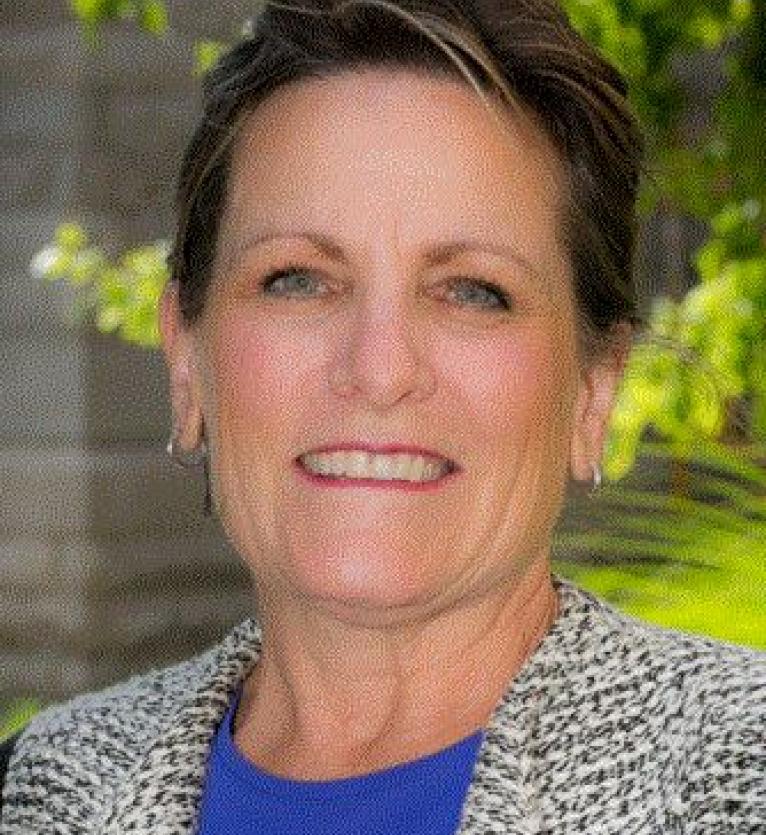
Kimberly Grassmeyer
I’ve been an educator at the postsecondary level for nearly 40 years – both as a Higher Education administrator in Student Affairs work, and as a part-time faculty member – at Creighton University and several other mid-western schools. In the midst of that time, I also worked as a consultant to universities across Canada, the United States and Mexico. It is my honor to be closing out my professional life at Creighton, where my professional, personal and faith values dance together in an enriching partnership.
As a seeker and a sinner I am wholly imperfect, which is to say I am the human that God created me to be. My faith is often quite strong; at other moments it is shaken to its core. I am not a scholar of the Bible nor do I consider myself to be faithful enough or wise enough to lead others in their faith journey…. which is why (apparently) my gracious colleagues believe that I may have something of value to say to the other seekers in the world! I hope that my thoughts and provocations may in some measure provide perspective, pause, laughter, grace, and some peace to you.