The Book of Tobit has been called a “Hebrew romance” but the few verses of this reading do not seem very romantic. Tobit does good works. After temporarily losing his eyesight, his wife has to get a job to make ends meet. One day she received a bonus in the form of a goat. Tobit questioned her about where she got it and insisted that she take it back. Although the text is somewhat obscure, her response to him seems to be that it was for naught that he did good works and that he is angry because God was punishing him in spite of them. The New Jerome Biblical Commentary states that the message of Tobit “is that God is indeed both just and free. Suffering is not a punishment but a test. God does, in the long run, reward the just and punish the wicked. The believer is called upon to trust God and to mirror in daily life the justice, mercy, and freedom of God.”
The psalmist could have been thinking of Tobit when he states that the man is blessed who “lavishly” gives to the poor. Good works do not disappear. Generosity endures forever. God does not forget what Jesus would later describe as that which is done to the smallest, the least. For our part, we fear the Lord, delight in his commands, and trust God. God promises to bless, grant posterity to, and exalt the just one.
Have you ever been in a situation where you were sure that people were out to get you? Jesus certainly had days like that. The gospels are filled with incidents where someone wants to kill him, trap him, trick him, or, as in the case of today’s reading, “ensnare him in his speech.” So, what type of snare do they come up with this time? First, they heap praise on him, none of which they actually believe. “You are a truthful man, you aren’t concerned about peoples’ opinions, you don’t care about a person’s status, but you teach God’s truthful way.” Where I come from, this would cause you to start looking around to see who is holding the knife.
The double-edged knife came, alright, in the form of a question that cut you no matter how you answered it. “Is it lawful to pay the census tax to Caesar or not?” If Jesus says, “No,” then he is guilty of treason. If he says, “Yes,” then he is looked upon as a collaborator with the occupation forces, one who won’t stand up for God and God’s people. How do you answer hypocrites who pretend to praise you but are really trying to get you in trouble? Jesus changed the focus of the discussion. The point they use to snare him is that deciding to pay the tax or not determines your loyalty to God. Jesus rejects this starting point. Asking for a coin, he says, “Whose image and inscription is this?” “Caesar’s,” they answer. Well, then, if his image is on it, it belongs to him, so pay it back to him. On the other hand, what has God’s image on it? Men and women: we have been made in the image of God. Then pay that back to God, Jesus says. The image of Caesar belongs to Caesar. The image of God belongs to God. Pay the rightful owner whatever belongs to them.
The people were amazed at Jesus. I, too, am amazed. I was amazed on April 15th (“tax day” in the U.S.) when I managed to pay Caesar. Now, if I can just pay God…
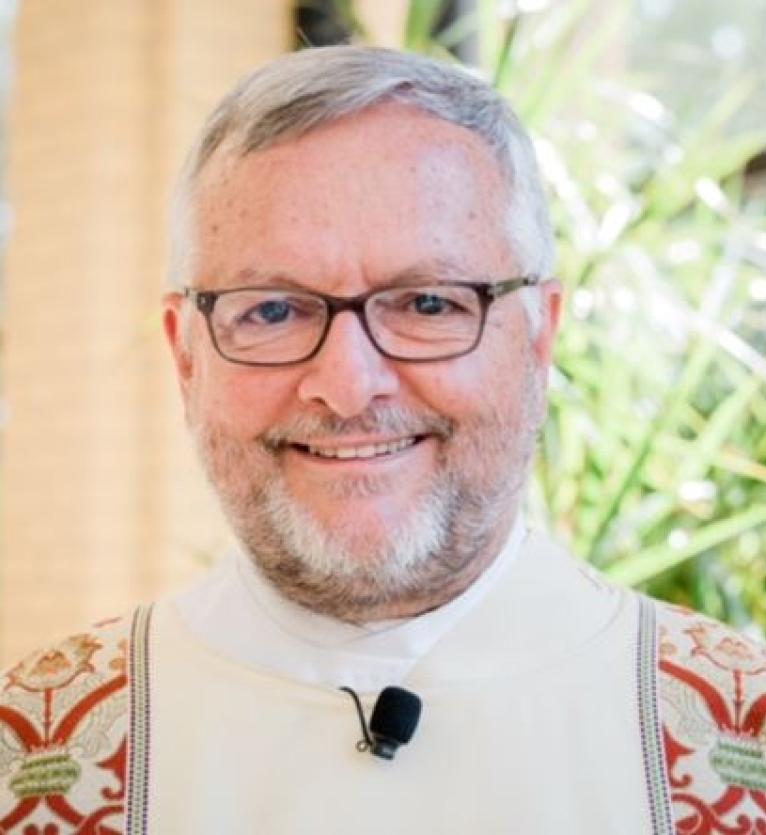
George Butterfield
I served as the Legal Reference Librarian at the Creighton University Law School Library from August, 2007, until August of 2017. I also taught Legal Research to first year law students and Advanced Legal Research to second and third year law students. In August of 2017 I took the position of Director of Evangelization and Catechesis for the St. John the Baptist Catholic Church in Edmond, Oklahoma, and served in that capacity until Covid hit and the church staff was cut in half. Recently I took a position with the St. Gerald Catholic Church in Omaha, Nebraska, and my wife and I moved back to the Omaha suburb of Papillion.
My wife, Deb, and I have been married since 1970. She grew up in Oklahoma City and I migrated south from southwestern Pennsylvania. God has blessed us with three children, four living grandchildren, and one great-grandchild. I spent the first thirty years of our marriage as a minister so our family moved a lot. We have lived in several states, including Pennsylvania, Oklahoma, Texas, Colorado, and California.
I enjoy walking, reading, listening to audio books, playing with my Pekingnese, Max, my Maltese-Schnauzer, Blaise, and seeing my grandkids grow up. I am a Catholic deacon, having been ordained by Archbishop George Lucas on May 5, 2012.
There is nothing to compare with reflecting on scripture. I feel privileged to participate in these daily reflections. Although we don’t know whether or not St. Francis ever said it, one idea associated with him is that we preach the gospel always and, when necessary, use words. May these reflections be gospel words, good news, of our gracious Lord Jesus Christ.