My daughter gave me a paperwhite narcissus. In winter I often buy kits of pre-planted bulbs in pots of dirt and watch them bloom to life on my kitchen windowsill. I set her gift aside and didn’t look at the box for a while. I was so disappointed when I finally opened it a few weeks ago and found a dry glass vase and a parched, papery bulb with two small, shriveled roots at the bottom. I had waited too long to get it into water!
I was ready to throw the bulb into the trash but decided to at least have my daughter see the bulb in water when she came over. As if by a miracle, this tiny “dead” bulb has now put out dozens of long, white roots. This morning I see two tiny blooms; flowers that will fill the kitchen with a lovely scent in a day or two. How did that dead brown bulb transform into beautiful flowers?
I think of that simple bulb when I look at today’s readings. We humans often look for dramatic hard work when we ask God for something. It can’t be as simple as a conversation with God, right? Shouldn’t I be on my knees with candles lit and dozens of prayers to read? And yet that’s not the way God works in our lives, or Naaman’s.
When the servant girl told Naaman’s wife that the prophet Elisha in Israel could cure Naaman’s leprosy, he and his king did not seem to even consider that a simple prophet could do that. Surely it would take the power of a king! So, loaded down with silver and gold pieces, festal garments and a letter from his own king, Naaman was presented to the king of Israel for a cure.
In dramatic fashion, the king of Israel is powerless to cure Naaman and rips his garments, a sign of grief and anger. Then the prophet, Elisha, sent word to the king of Israel, “Let him come to me….”
When Naaman arrived at Elisha’s house accompanied by the magnificent sight of his horses and chariots, Elisha does not even come out to meet him. He simply sends word to Naaman to wash seven times in the Jordan River. Perhaps embarrassed at this slight, Naaman angrily leaves because he expected a more dramatic reception and healing. He wanted the prophet to come out to him, raise his hands over the leprosy and pray loudly. What kind of “healing” is this to wash in some river?
I picture Naaman with a disgusted snort, turning his party around and starting for home. Yet his servants suggested that he would have done any dramatic or difficult thing Elisha had suggested. Although Elisha’s suggestion was simple, Naaman should try it. So, he washed in the Jordan seven times and was healed, his skin “like the flesh of a little child.”
We can be like Naaman and refuse to believe that healing from God requires a lot of work from us. We might surround ourselves with prayer books or theology books, educating ourselves about God before we ask for something. We believe deep in our hearts that we need to be perfect before God. We might feel we have to “know” God before we ask something. We forget that with God it is a heart to heart conversation. The God who loves us endlessly does not require us to be perfect before we ask for something. God always loves us and simply waits for us to speak. We don’t need fancy words any more than Naaman needed anything more than washing in the River Jordan.
I wonder if our search to do it “right” before we speak to God, the right studies, the right posture or devotional practices, can even be our way of keeping God at a distance from us. If I feel I have to be perfect before I speak to God, then I keep working on perfection, rather than speaking what is in my heart. I might be afraid of what I encounter if I am truly in an easy loving conversation with God. What will I be asked? How will my life be changed? If I keep God at a distance, I won’t face my fears of God.
Greg Boyle, S.J. who serves gang members in Los Angeles, tells each one of them as they face him in their disgrace, that they are loved by God at this very moment. “You are exactly what God created you to be.” And in all of our imperfection, so are we.
In today’s gospel Jesus repeats the story of Naaman and of a humble widow who receive help in the midst of a famine. He may be trying to tell us that God comes simply and humbly, but his listeners at the synagogue refuse to listen. They are blind to his message of turning to God in humility and simplicity and maybe believe that only their rites, ritual and law are the real way to God. And they are blind once again when Jesus simply slips from the midst.
The psalm response for today asks, “When shall I go and behold the face of God?” Perhaps we will behold that face that longs to see us, when we drop our fears and are willing to sit in simple silence and then speak to our loving God.
Loving God, you know how imperfect I am, and yet you look at me with joy and love, waiting for me to just turn my face to you. You long for me to ask for your help, and I too often worry, as if I don’t deserve it. Teach me to trust your love for me and your deep knowing of all parts of my life.
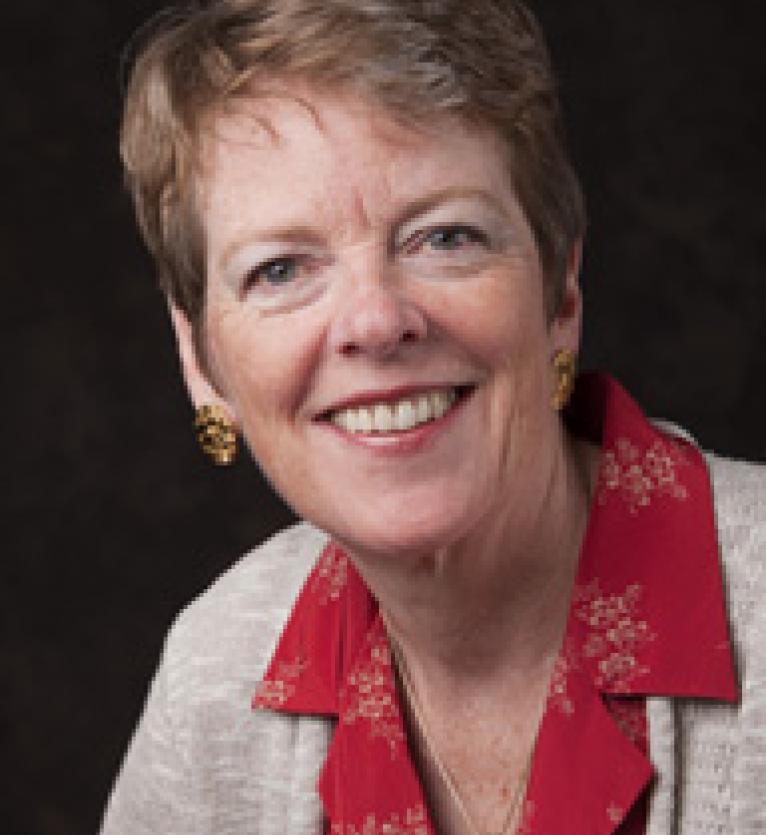
Maureen McCann Waldron
The most important part of my life is my family – Jim my husband of 47 years and our two children. Our daughter Katy, a banker here in Omaha, and her husband John, have three wonderful children: Charlotte, Daniel and Elizabeth Grace. Our son Jack and his wife, Ellie, have added to our joy with their sons, Peter and Joseph.
I think family life is an incredible way to find God, even in (or maybe I should say, especially in) the most frustrating or mundane moments.
I am a native of the East Coast after graduating in 1971 from Archbishop John Carroll High School in suburban Philadelphia. I graduated from Creighton University in 1975 with a degree in Journalism and spent most of the next 20 years in corporate public relations in Omaha. I returned to Creighton in the 1990s and completed a master’s degree in Christian Spirituality in 1998.
As our children were growing up, my favorite times were always family dinners at home when the four of us would talk about our days. But now that our kids are gone from home, my husband and I have rediscovered how nice it is to have a quiet dinner together. I also have a special place in my heart for family vacations when the kids were little and four of us were away from home together. It’s a joy to be with my growing family.
Writing a Daily Reflection is always a graced moment, because only with God’s help could I ever write one. I know my own life is hectic, disjointed and imperfect and I know most of us have lives like that. I usually write from that point of view and I always seem to find some sentence, some word in the readings that speaks right to me, in all of my imperfection. I hope that whatever I write is in some way supportive of others.
It’s an incredibly humbling experience to hear from someone who was touched by something I wrote. Whether the note is from someone across campus or across the world, it makes me realize how connected we are all in our longing to grow closer to God.