I recently read a transcript of the speech that Charlie Chaplin gave at the end of The Great Dictator, his first film with dialogue. 86 years ago, he spoke passionately on how “Greed has poisoned men’s souls, has barricaded the world with hate, has goosestepped us into misery and bloodshed.” He goes on to make a plea for humanity specifically citing the call in today’s Gospel. I find both Chaplin’s response to his times and Jesus’ words from 2,000 years ago compelling and relevant to our world today.
In today’s Gospel, the Pharisees ask Jesus when the Kingdom of God will come. Jesus declares, “For behold, the Kingdom of God is among you.” Expecting something more grandiose, the Pharisees fail to recognize Christ’s transforming power that is in their midst.
Today’s Epistle offers a concrete example of this Kingdom. Paul appeals to Philemon on behalf of Onesimus, asking him to welcome Onesimus no longer merely as a slave, but as a beloved brother in Christ. Rather than relying on authority or command, Paul appeals to love, human dignity, and the transforming power of a relationship grounded in Christ.
Given my professional training, I often find myself at the intersection of two ways of seeing the world. Physics teaches me to look beneath appearances and recognize that often there is more to this world than my senses suggest. Much of physics involves discovering realities that cannot be directly observed. We cannot see an electron with the naked eye or observe spacetime as we would a tree or mountain. Yet through observation, mathematical reasoning, and the effects these realities produce, we gain insight into the deeper structure of the world.
Similarly, I find myself invited to look beyond what is immediately visible and recognize God’s presence in the ordinary circumstances of life. While the Kingdom of God is not a physical object waiting to be measured, faith cannot be reduced to an equation, and God is not a hypothesis that a laboratory experiment could prove or disprove (although sometimes I wish that it were that simple), physics reminds me that the set of what is visible does not exhaust the set of what is real. I personally get a sense that God’s Kingdom is already present in quiet acts of mercy, the courage to forgive, the pursuit of truth, and the willingness to love those who society overlooks.
This understanding of the Kingdom becomes especially concrete in Paul’s letter. Paul’s appeal challenges me to recognize the inherent dignity of every person, regardless of wealth, status, or social position. His request that Philemon welcome Onesimus as a brother is more than a call for kindness; it invites faith to reshape human relationships. The Kingdom becomes visible when the excluded are welcomed, power gives way to compassion, and reconciliation takes precedence over privilege. Paul even offers to repay whatever Onesimus owes, thereby identifying himself with the person whose situation he hopes to change. His words challenge me to consider whether I am willing to do more than acknowledge injustice to go further accepting a personal responsibility for healing it.
I see Chaplin’s speech, today’s Gospel, and Paul’s letter sharing a common invitation, that is, to recognize our shared humanity and make it visible through our actions. This forms a basis for my prayer today.
Dear Lord,
Your love transforms human relationships.
It restores dignity to those to whom it has been denied.
Too often I merely search for the Kingdom of God as somewhere far beyond.
Help me to learn to recognize the presence of Your Kingdom.
Give me the fortitude to participate in it through the way that I live.
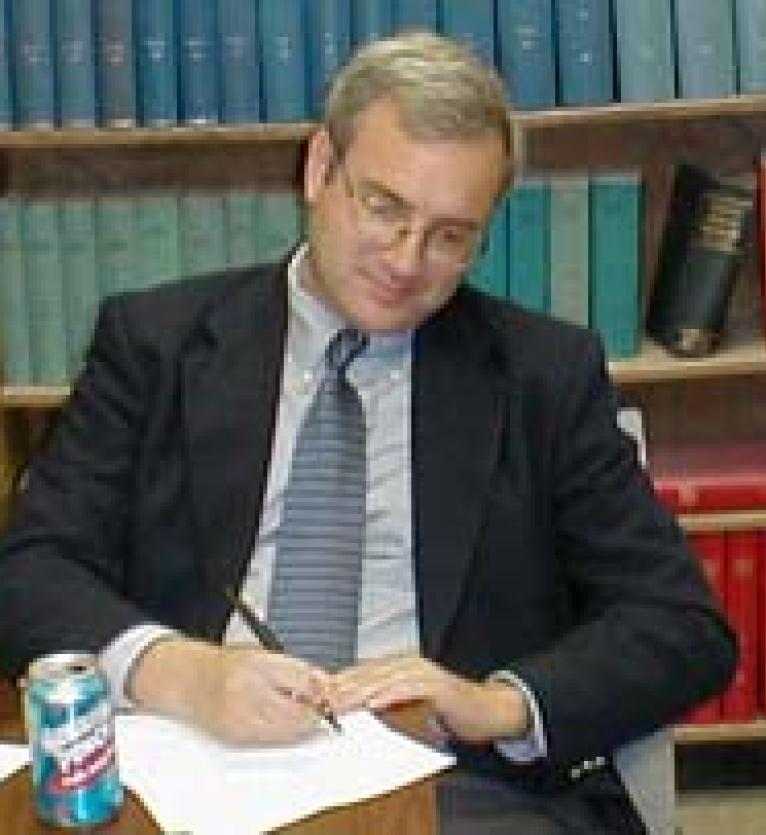
Mike Cherney
I grew up in Milwaukee and have lived in Madison, St. Paul, Hamburg, Geneva, Omaha and Boston. I taught for 27 years in the Creighton Physics Department. Now I am mostly retired and have returned to the Milwaukee area where my wife recently became President of Mount Mary University. I continue to work with Creighton students on projects in high energy nuclear physics at Brookhaven National Laboratory on Long Island and at CERN just outside Geneva, Switzerland. We have two sons and three grandchildren who all live in the northern suburbs of Chicago.
I am a person who asks questions. This often leads me down a challenging path.