Where Love Reigns
There has been a lot of talk about kings lately. Many say they want no king in our secular world—and I understand why. We often associate kings with dominance, wealth, control, and people kept in line through fear or deception. Honestly, I wouldn’t want that kind of ruler either.
But today we celebrate Christ the King, whose reign looks nothing like the rulers we fear. He does not rule from a palace or a gilded mansion, but from a cross, revealing a kingship grounded not in force, spectacle, or lies, but in love, mercy, vulnerability, and truth.
Ignatius helps us pray with this mystery through the Two Standards and the Call of the King. We are invited to notice which “king” we follow—the world’s values of riches, honor, and power, or Christ’s values of humility, compassion, and self-giving love. Today’s Gospel places these two standards on opposite sides of Calvary: the rulers demanding power and spectacle, and Jesus offering forgiveness and mercy to the one who simply asks to be remembered. And this same Christ calls to us, “Come with me. I am already where I am calling you to be”—among the poor, the grieving, the forgotten, and all those longing for hope. This is the heart of the feast: a King who chooses us, calls us by name, and invites our freely offered “yes.”
And this is why the feast moves me so deeply. I tremble—not in fear, but in awe—that the Lord calls someone like me to follow Him. I stand in awe of all Jesus has done, and I also find myself shaking and weeping at the foot of the Cross—sometimes in confusion, sometimes in sorrow, always aware of my own sinfulness. This feast should move us; it should be, in the most honest sense, gut-wrenching. Because here is our King: vulnerable, poured out, offering mercy in the very moment He is rejected and abandoned. And He did not want the Cross. In Gethsemane, He begged the Father to let the cup pass. Yet He trusted the Father’s will more than His own fear, and He embraced the Cross out of love for us and fidelity to His mission. And still, He calls my name. And somehow, standing at the foot of the Cross, I find myself saying: “Lord, I will follow You—sinner that I am—because You are the King who calls me.”
We know that it does not end on the Cross. Jesus is risen, and the Holy Spirit is with us. But He also shows us that this may be the cost of following Him where He leads. St. Paul calls the cross a “stumbling block” and says that discipleship often makes us “fools for Christ.” Standing at the foot of the Cross, I understand why. Nothing about Christ’s kingship fits the categories of strength our world admires. Love like this is misunderstood. Mercy like this is mocked. Vulnerability like this appears foolish. And yet it is at the Cross—in what looks like defeat—that the true King is revealed.
Yet even here, our King remains close. He stands with us in the very places where discipleship becomes costly, where love becomes vulnerable, where fidelity requires courage. He has gone ahead of us into all of it—and He invites us to follow, one step, one yes, one moment of trust at a time.
Although I write from the perspective of a Jesuit priest, I know that Christ’s kingship is lived most often far from the places where I stand. The kingdom unfolds in the ordinary rhythms of daily life—in homes, workplaces, schools, and all the places where people love, serve, struggle, forgive, and begin again. Christ the King walks into the ordinary and the chaotic. And in that very normal, very messy life, He invites parents, spouses, caregivers, and all who carry the quiet burdens of love to say their own “yes”—not dramatic, not heroic, but the “yes” that gets lived in a thousand small acts of love every day.
It is often in homes—not churches—that the Cross becomes a classroom for love. And it is in families—not palaces—that Christ’s kingdom most quietly takes root.
I invite you to continue this reflection with The Summons by John Bell
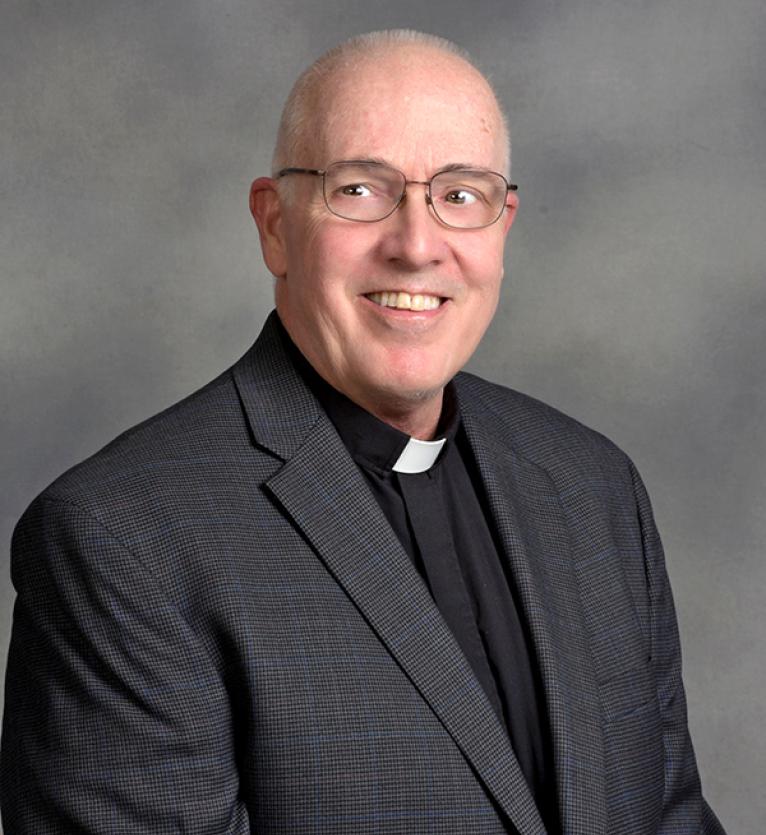
Rev. Jim Caime, SJ
My email link is now correct.
I have lived and worked in thirteen states, as well as in Europe, Latin America, and East Asia, traveling around the world for work. I tend to approach life with a global perspective—yet always with a keen awareness of the local and the individual.
One of the most powerful meditations for me in the Spiritual Exercises is the meditation on the Incarnation, where the Trinity looks upon the world and sees the need to “be made flesh” in our lives. This deeply shapes my understanding of faith and presence.
Math, science, and hard data help us understand our lives and circumstances, but without the arts—poetry, music, and beauty—we would lack the language to express the inexpressible. I am drawn to Ignatian spirituality because it affirms that God is present in all things, always seeking to communicate with us, personally and profoundly.
I am a dreamer, deeply desiring to see the world as God does—with all its possibilities—while never turning away from its pain. And, thankfully, I also have a wicked sense of humor, which helps me (and hopefully others) navigate the world’s darkness with a bit more light.
At the same time, I hold close the wisdom of the prayer attributed to St. Oscar Romero, which reminds us that “we are merely laborers and not the Master Builder.” We are never the be-all and end-all—that is God’s place. This truth keeps me both humble and hopeful. Also, I am a sinner, always in need of God’s love, mercy and grace.
It is a privilege to contribute to this ministry. God’s Word is alive and active, and I hope my reflections offer you meaningful thoughts for your own prayer.